

Witness Guidance
Understanding witnesses for your will - who can witness, their responsibilities, and best practices.
Last reviewed
Understanding Witnesses
What Are Witnesses?
Witnesses are individuals who observe you signing your will and then sign the will themselves to confirm they witnessed the signing. Their role is to provide independent verification that you signed the will voluntarily and were of sound mind.
Why Are Witnesses Required?
Most jurisdictions require witnesses to help ensure the validity of your will. Witnesses provide legal evidence that:
- You (the testator) actually signed the will
- You appeared to be of sound mind when signing
- You signed voluntarily without coercion
- The document being signed was understood to be your will
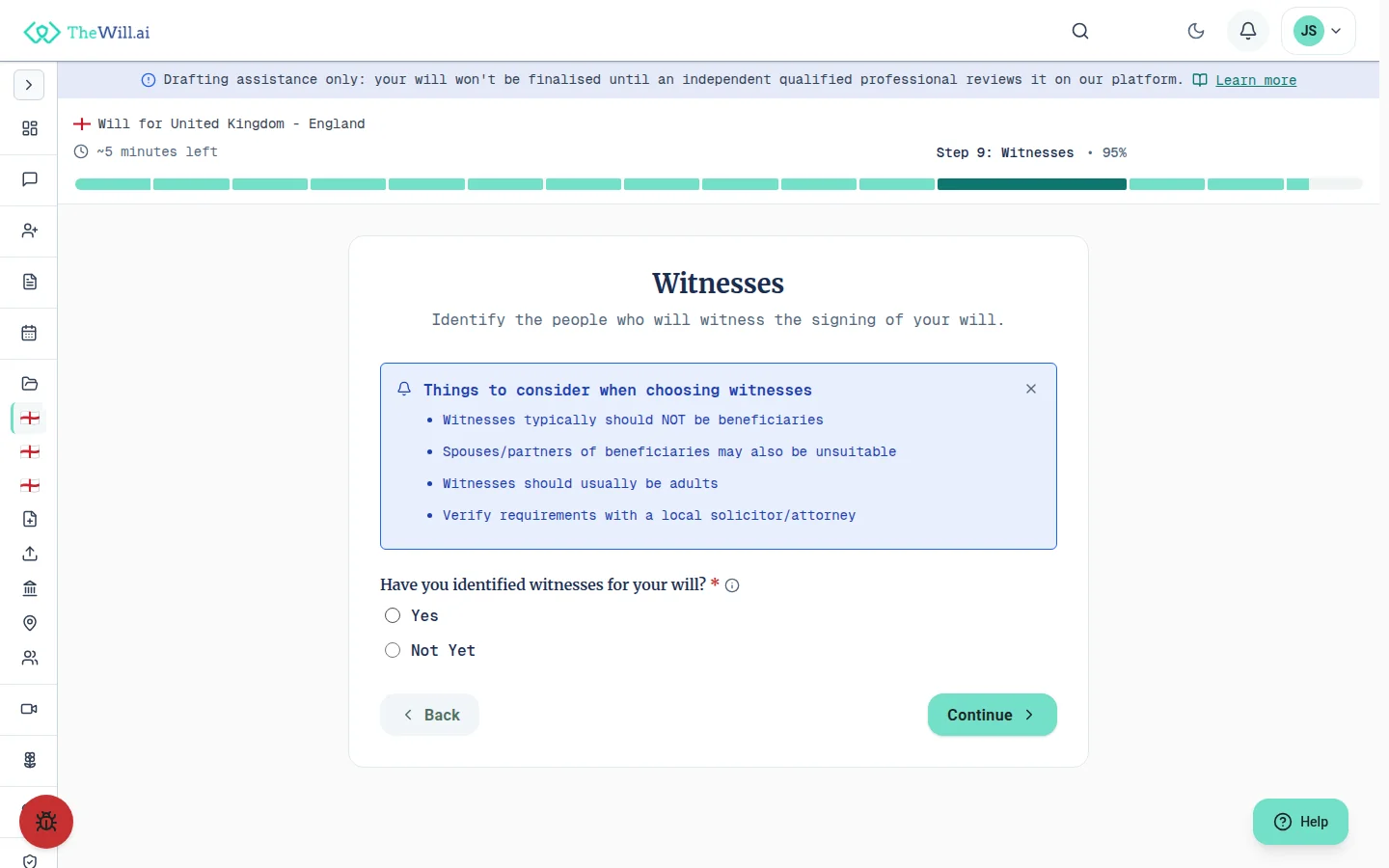
Recording Your Witnesses (Step 9)
What You Are Asked For
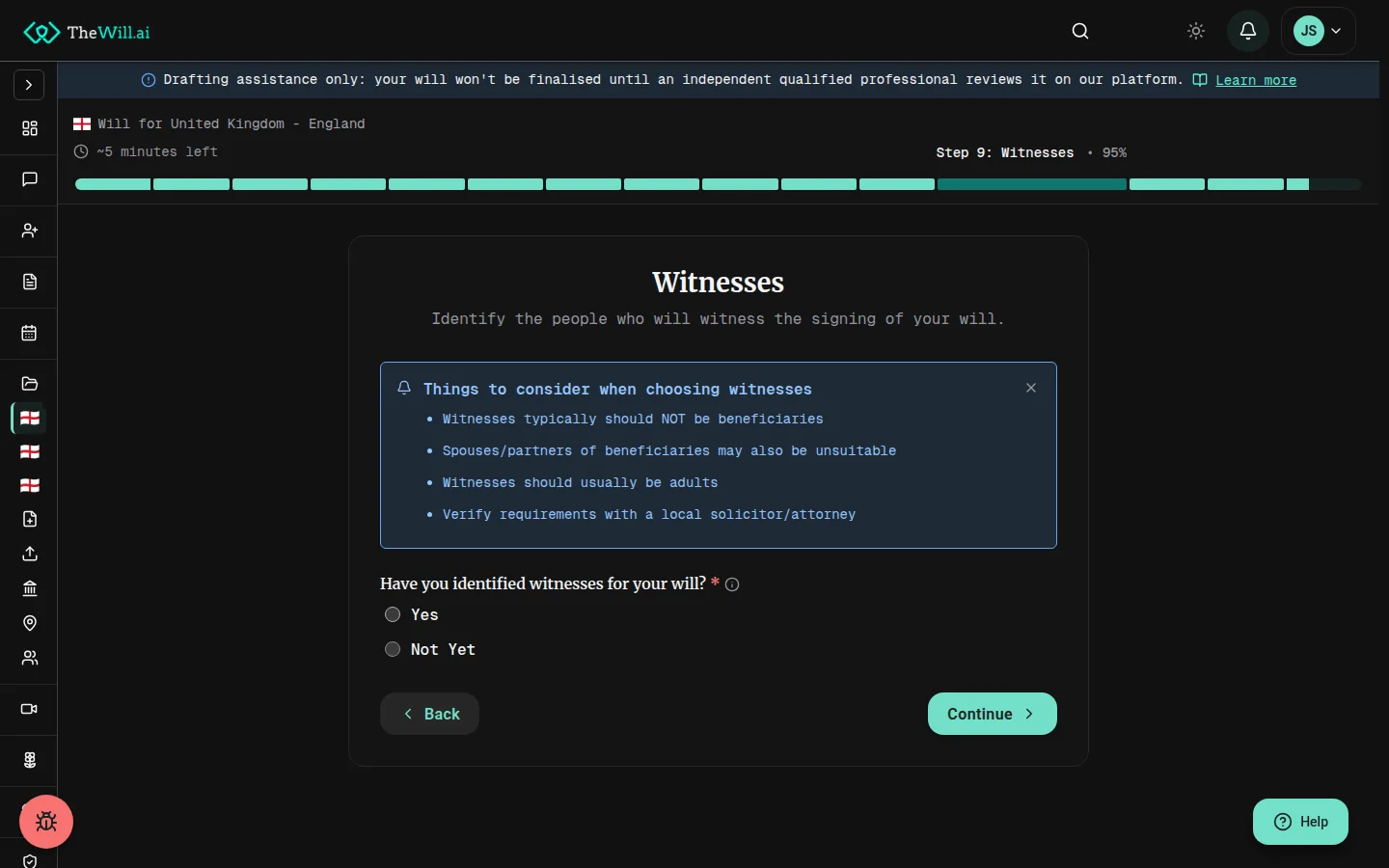
Step 9 of the will builder records who will witness your signing. For each witness you give their name, date of birth, relationship to you, occupation, and an address. The address can be the same as yours, one of your saved addresses, or a different address you type in. Email and phone number are optional.
- Number of witnesses comes from your jurisdiction - the step shows how many the jurisdiction of your will needs (two in most places, one in United Kingdom - Scotland) and cannot be completed with fewer
- How you will sign - where your jurisdiction recognises more than one way of signing, the step asks how you plan to sign (see Ways of Signing Your Will below)
- Up to four - use "Add Witness", then "Add Another Witness", until you have added the ones you need
- Minimum age comes from your jurisdiction - the builder checks each witness against the minimum witness age recorded for the jurisdiction of your will
- Not sure yet? - you can answer that you have not chosen your witnesses yet and return to the step later
What Appears on the Document
Your generated will ends with a signing section holding two witness blocks. Each block has space for a signature, full name, address, occupation, and date. Where you have already entered a witness, their name, address, and occupation are printed for you; where you have not, the block is left blank to complete by hand at the signing.
Who Makes a Good Witness?
Eligible Witnesses
Choosing the right witnesses is important for ensuring your will is valid. Generally, good witnesses include:
- Adults (typically 18 or older) who are mentally capable of understanding what they are witnessing
- People who are NOT beneficiaries of your will - witnesses should not receive anything under the will
- People who are NOT married to or in a civil partnership with a beneficiary - spouses and civil partners of beneficiaries should also not witness
- Friends, neighbours, colleagues, or professional witnesses - people who know you but have no financial interest in your estate
Who Should NOT Be a Witness
- Anyone named as a beneficiary in your will
- The spouse or civil partner of any beneficiary
- Anyone who lacks mental capacity to understand witnessing
- Minors (under 18 in most jurisdictions)
- Anyone who cannot see (in some jurisdictions)
What Witnesses Need to Do
During the Signing Ceremony
When you sign your will, your witnesses have specific responsibilities:
- Be physically present when you sign your will - both witnesses should be in the same room with you
- Watch you sign or acknowledge your signature - they must actually see you sign or hear you confirm you signed
- Sign the will themselves in your presence - you must watch them sign as witnesses
- Provide their full name, address, and occupation - this information is typically recorded on the will
After Signing
Witnesses may be called upon later if there are any questions about the validity of your will. They should:
- Remember the signing event and circumstances
- Be available to provide testimony if the will is contested
- Keep their contact information updated with you if possible
Ways of Signing Your Will
On the witnesses step you can tell us how you plan to sign your will. Most people sign it themselves in the usual way. The law in many places also recognises other ways for someone who cannot sign, or cannot read, to make a valid will. We only offer the ways recognised for the jurisdiction your will is made under, and we print the matching signing and witnessing wording on your will. The options below are general information, not advice on which one suits you.
The ways we may offer
- Signing in the usual way: you sign the will yourself in front of your witnesses.
- Signing with a mark: if you cannot write your name, you make a mark (such as a cross) in front of your witnesses, usually after the will has been read to you.
- Someone signing at your direction: another person signs your name for you, in your presence and because you ask them to, in front of your witnesses. We ask for their name and address, and they should not be one of your witnesses.
- Having the will read over to you: if you cannot read the will, it is read aloud to you before you sign, and the wording records that this happened.
- Notarial execution: where the law provides for it, a notary or other authorised person signs for someone who is blind or unable to write, after reading the will to them. We ask for their name, their capacity and the reason you cannot sign.
Where each option is offered
- United Kingdom - England and Wales, United Kingdom - Northern Ireland, Ireland, Australia, New Zealand, Hong Kong, Singapore, India, Canada (other than Quebec) and the United States (other than Louisiana): signing in the usual way, with a mark, by someone at your direction, or after the will is read over to you. Two witnesses sign.
- United Kingdom - Scotland: signing in the usual way, after the will is read over to you, or notarial execution. One witness signs, and the will is signed on every page.
- Canada - Quebec, United States - Louisiana, Malta, Sri Lanka, Nepal, Pakistan, Bangladesh and anywhere else: we offer signing in the usual way only. The formalities for other ways of signing there go beyond what we can print, so if you cannot sign in the usual way, take advice from a qualified legal professional before you sign.
Important Considerations
Jurisdiction Variations
Witness requirements vary by jurisdiction. The guidance on this page reflects common practices; a legal professional can confirm the specific requirements that apply where you live. Some variations include:
- Number of witnesses required (usually 2, but some jurisdictions require more and some, such as United Kingdom - Scotland, only 1)
- Age requirements for witnesses
- Whether witnesses must be present together or can sign separately
- Special rules for self-proving affidavits or notarisation
Best Practices
Before the Signing
- Talk to your witnesses beforehand: Make sure they understand what witnessing involves and are willing to serve as witnesses
- Confirm their availability: Arrange a time when both witnesses can be present together with you
- Verify their eligibility: Double-check that they are not beneficiaries or related to beneficiaries
- Have their details ready: Collect their full names, addresses, and occupations in advance
Maintaining Records
- Keep contact information updated: If your witnesses move or change contact details, update your records
- Consider backup witnesses: If circumstances change, be prepared to update your will with new witnesses
- Store witness information securely: Keep a record of who witnessed your will and how to contact them
Professional Witnesses
If you have difficulty finding suitable witnesses, consider using professional witnesses such as solicitors, notaries, or will-writing services. They can provide reliable, impartial witnessing and maintain records of the signing.
Frequently Asked Questions
Can family members be witnesses?
Family members can be witnesses as long as they are not beneficiaries of your will and are not married to or in a civil partnership with a beneficiary. However, it's often better to use non-family members to avoid any appearance of undue influence.
Can my executor be a witness?
Yes, executors can usually be witnesses, provided they are not also beneficiaries. However, some jurisdictions have specific rules, so check local requirements.
Do witnesses need to read my will?
No, witnesses do not need to read your will. They are only witnessing your signature, not the contents of the document. Your will's contents can remain private.
Can I have more than 2 witnesses?
Yes. Most jurisdictions we support need two witnesses (United Kingdom - Scotland needs one), and you can record up to four in the will builder. Having additional witnesses can provide extra security in case one witness becomes unavailable later. The signing section printed on your will provides at least as many witness blocks as your jurisdiction requires.
What if a witness dies before I do?
Your will remains valid even if a witness dies before you. However, if the will is contested, it may be harder to prove validity. Consider updating your will periodically to ensure witnesses are still available.
Can’t find what you’re looking for?
Our support team is here to help. Contact us and we’ll get back to you as soon as possible.
Contact Support